← → 翻页 · B 静态 · ESC 索引
GRADUS AISchool introduction
01/17
Assessment → Understanding → Next action
GRADUS AI
From answers to next steps.
An AI learning platform that turns marking evidence into a continuously updated plan for each student.
Introduction deck · Schools & educatorsVOL. 01 · FOREST INK
GRADUS AIThe problem
02/17
Most systems stop too early
A mark records the past. Learning needs a decision about what happens next.
Students often receive a score, an explanation and a new worksheet as separate events. The evidence is lost between them.
Conventional practice
Answer → score → move on
iFeedback is detached from the next task.
iiRepeated errors look like isolated mistakes.
iiiTeachers reconstruct learning needs manually.
Gradus AI
Answer → evidence → next action
iEach marked response updates the learner profile.
iiError patterns persist across sessions and topics.
iiiPractice responds to the evidence already collected.
The gap is not more content. It is continuity.VOL. 01 · FOREST INK
GRADUS AIWhat Gradus is
03/17
One learning layer
Assessment intelligence for the work students already do.
Gradus AI connects marking, diagnosis, learner state and task selection instead of treating them as separate features.
01 · Read
Interpret answer evidence
Compare the response with marking-scheme requirements and identify what was demonstrated, missed or unclear.
02 · Remember
Build a student model
Carry topic performance, misconception patterns, support needs and recency forward across sessions.
03 · Act
Choose the next move
Select practice, feedback or coaching that addresses the highest-value learning gap now.
Designed for formative learning: the purpose of marking is to improve the next attempt, not to replace high-stakes examination decisions.
A system of connected decisionsVOL. 01 · FOREST INK
GRADUS AIStudent learning
04/17
The learning loop
Every response becomes evidence. Every new task tests the model.
The loop repeats at question, topic and paper level.
01
Attempt
The student answers a question or paper.
02
Mark
The system maps the response to required evidence.
03
Diagnose
It separates slips, gaps and recurring misconceptions.
04
Prescribe
It chooses the next explanation, hint or task.
05
Practice
The student works at the right level of support.
06
Update
New evidence strengthens or corrects the model.
Shorter feedback loops · more purposeful practiceVOL. 01 · FOREST INK
GRADUS AIProduct experience
05/17
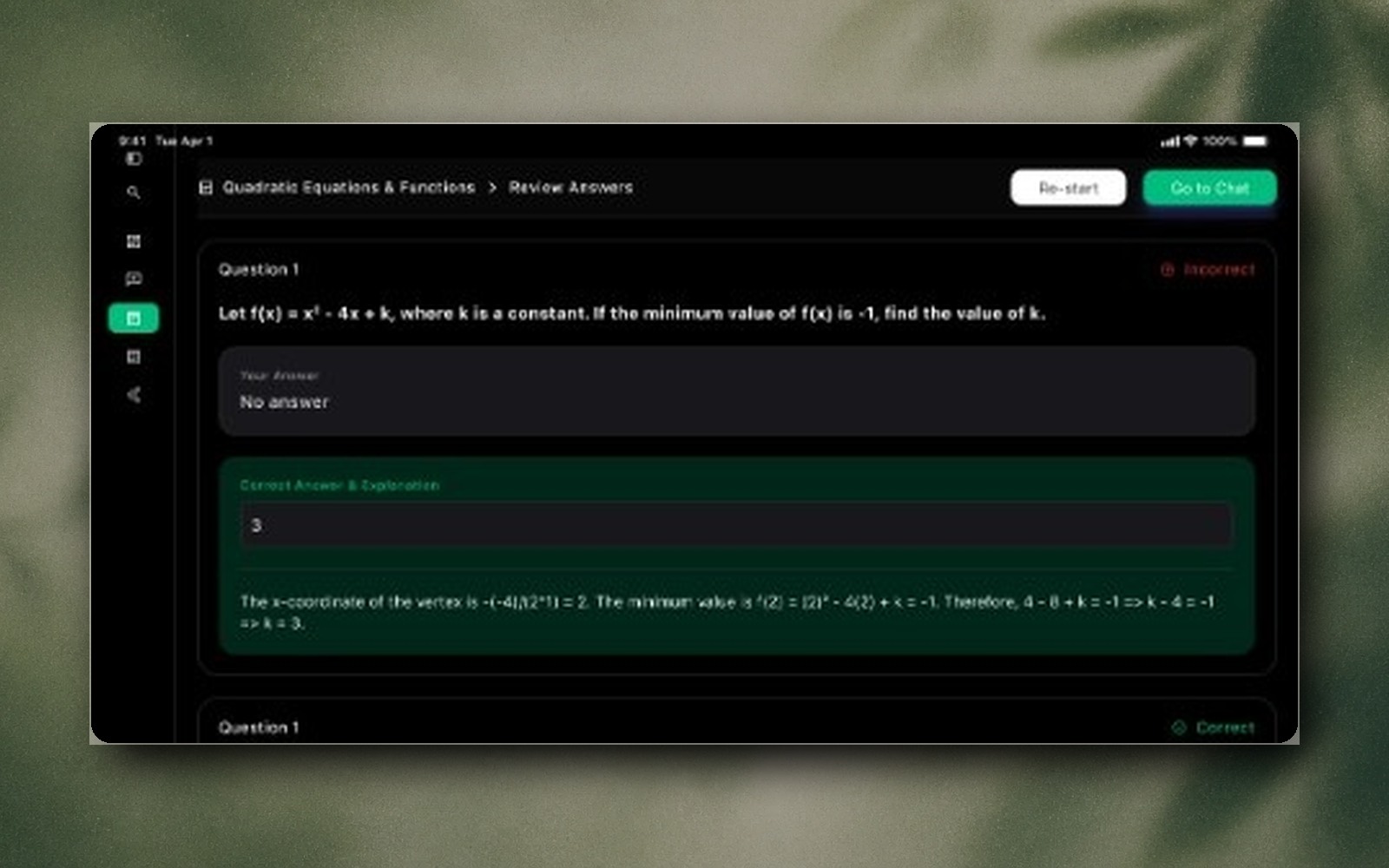
Marking that teaches
Show the evidence, not only the score.
Students see the required answer evidence, the explanation behind it and the gap between their response and the marking scheme.
iImmediate formative feedback
iiMarking-scheme-aligned explanation
iiiEvidence captured for future practice
Student marking flow
Student marking flowMock data · current product
The marked answer becomes reusable learning evidenceVOL. 01 · FOREST INK
GRADUS AIProduct experience
06/17
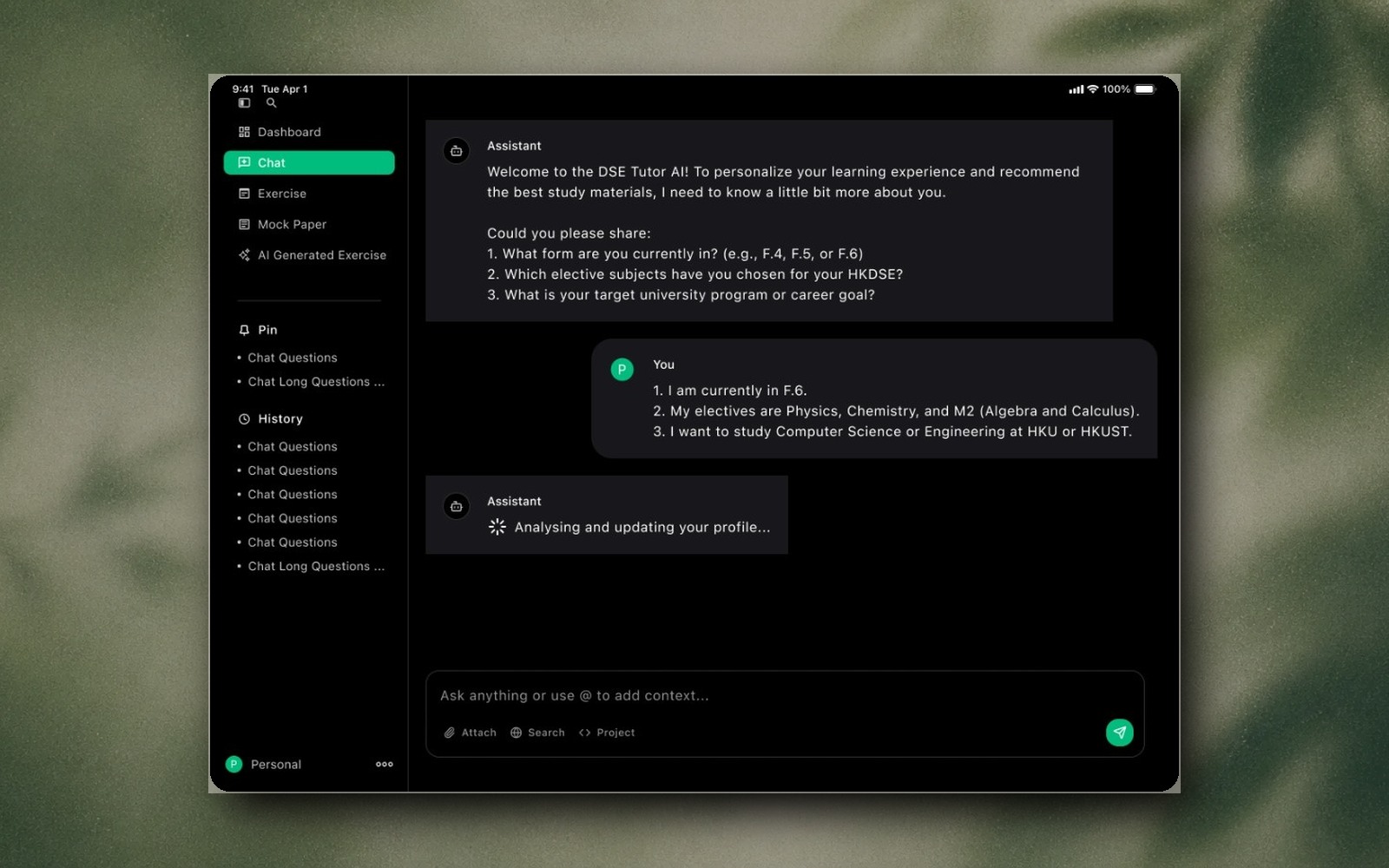
Gradus AI coaching
Gradus AI coachingMock data · current product
Context-bound coaching
A coach that knows what the student has already shown.
Gradus AI can use the learner profile, recent answer evidence and course context to guide the next step.
The coach is not positioned as an open-ended answer machine. Its value comes from staying anchored to the learner's work and learning goals.
Profile-awareCourse-groundedNext-step focused
Guidance with memory and boundariesVOL. 01 · FOREST INK
GRADUS AILearner model
07/17
Beyond a percentage
A learner profile should explain why performance changes, not merely report that it changed.
Gradus AI maintains multiple kinds of evidence so the same score can lead to different next actions.
Signal 01
Topic mastery
What the student can demonstrate, at which level and how recently.
Signal 02
Error patterns
Recurring misconceptions, procedural slips and missing evidence.
Signal 03
Support dependence
Whether success required hints, examples or repeated attempts.
Signal 04
Practice history
What has been attempted, deferred, repeated or retained over time.
Two students with 70% do not necessarily need the same next question.
Longitudinal evidence changes the decisionVOL. 01 · FOREST INK
GRADUS AIExpected impact
08/17
Directional mechanism
Growth is expected to come from better allocation of practice.
With the same study time, a tighter evidence-to-action loop should reduce low-value repetition and increase attention on unresolved gaps.
This is a conceptual comparison, not a measured result claim. Gradus AI will publish outcome figures only after controlled evaluation.
Generic repetition Evidence-led practice Practice over time Demonstrated mastery
Illustrative shape only · no outcome data implied
Mechanism first · measurement followsVOL. 01 · FOREST INK
GRADUS AISchool visibility
09/17
From individual evidence to class priorities
Teachers should see where attention is needed before the next assessment.
The same answer evidence can support class-level topic patterns, intervention signals and drill-down into a student's history.
View
Class priorities
Topics and misconceptions shared across a group.
Trace
Student evidence
The marked work and history behind each signal.
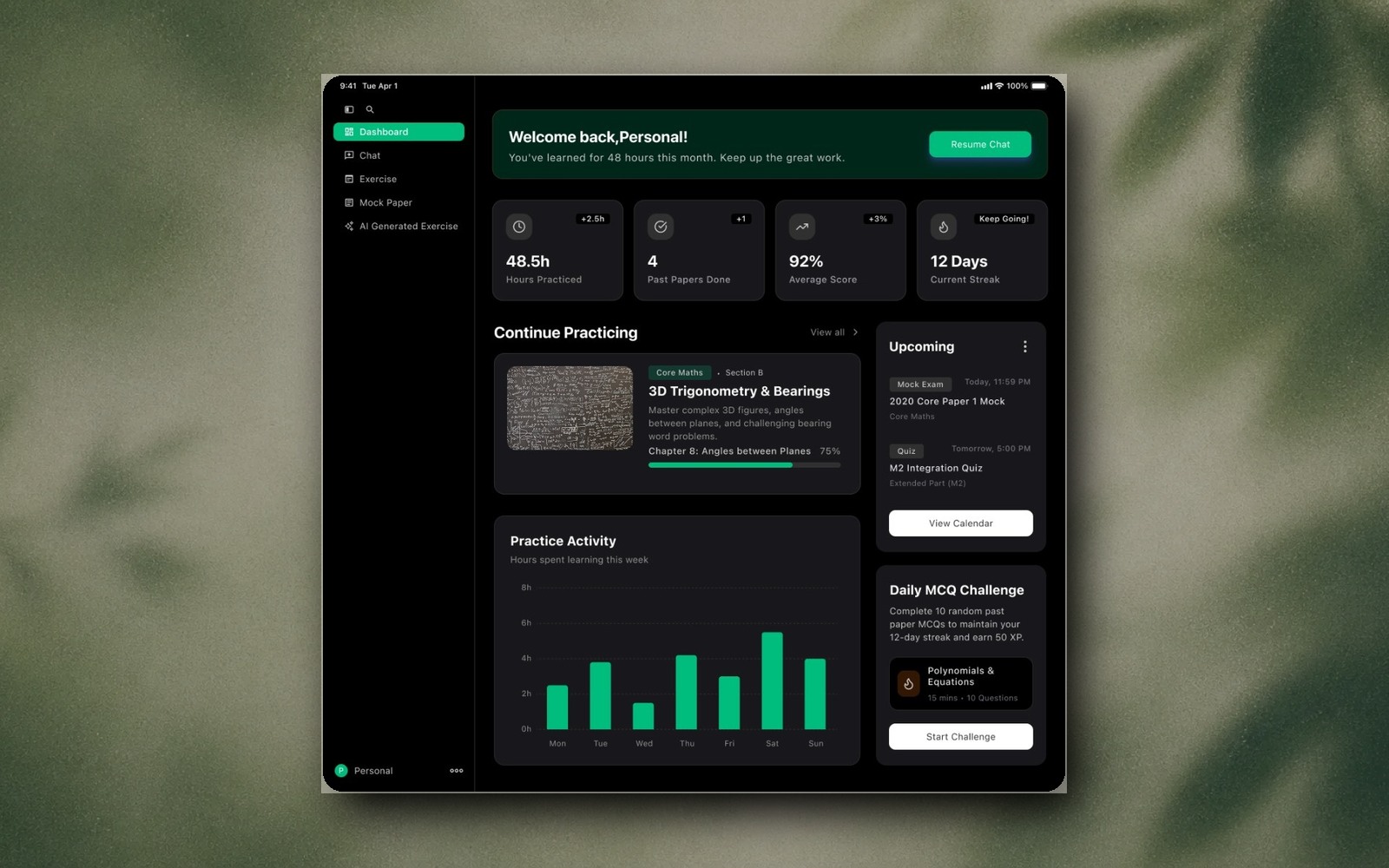
The screen shown is the current student dashboard mock. Replace 03-dashboard.jpg with the real teacher analytics screen when available.
Dashboard visual
Dashboard visualPlaceholder for teacher analytics
Transparent placeholder · no teacher-screen claimVOL. 01 · FOREST INK
GRADUS AIReporting views
10/17
One evidence model
Three audiences. Three useful views.
The same learning evidence can guide the learner, summarize progress for parents and surface intervention priorities for schools.
Current data foundation · Learner
Mastery & next focus
See strengths, gaps and the next topic to practise.
ALGEBRAGEOMETRY TRIGSTATISTICS PROBABILITYCALCULUS
Next focus: statistics · lower support dependence
Concept · Parent summary
Progress, effort & support
Translate detailed evidence into a clear weekly story.
W1W2W3 W4W5W6 DEMONSTRATED MASTERY
Consistent in 4 of 5 weeks · support: review geometry
Roadmap · School analytics
Class patterns & intervention
Prioritize topics and groups before the next assessment.
C1C2C3 C4C5 ALGEBRAGEOMETRY TRIGSTATISTICS LOWERHIGHER SUPPORT NEED
Priority signal: geometry · three classes need review
Illustrative reporting views using mock data. Learner reporting has a current product foundation; parent summaries and school analytics remain concept / roadmap items until implemented.
One evidence model · audience-specific reportingVOL. 01 · FOREST INK
GRADUS AIUse cases
11/17
Everyday use
Four moments when evidence should change what happens next.
Each scenario starts with real learner work and ends with a clearer action for the student or the adults supporting them.
Current product · Learner
Correct a past paper
After completing a question or mock paper:
Submit the response
Mark against required evidence
Explain what was missed
Prescribe the next task
Outcome: practice starts where the paper exposed a gap.
Roadmap · Teacher
Plan the next intervention
Before the next lesson or support session:
Review class patterns
Inspect answer evidence
Assign focused practice
Monitor the reattempt
Outcome: intervention begins with evidence, not an average.
Concept · Parent
Understand weekly progress
During a regular family check-in:
See effort and consistency
Understand mastery movement
Know the next focus
Support without guessing
Outcome: a clear story without every technical detail.
Roadmap · School
Prioritize across classes
Across cohorts, topics and terms:
View engagement patterns
Compare topic signals
Identify support priorities
Trace back to evidence
Outcome: a cohort view that remains auditable.
Status labels distinguish the current learner workflow from parent-summary concepts and teacher / school analytics roadmap items.
Actor → moment → Gradus action → outcomeVOL. 01 · FOREST INK
GRADUS AIDifferentiation
12/17
One marking scheme. Five connected decisions.
The same evidence standard drives the entire learning experience.
This continuity is the product: scoring, explanation, learner-state updates, task selection and analytics use one shared interpretation of what counts.
01
Score
Which criteria were demonstrated?
02
Explain
What evidence was missing or incorrect?
03
Update
What changes in the student model?
04
Select
What is the highest-value next task?
05
Surface
What should student and teacher see?
Gradus AI turns a marking scheme from a scoring document into a learning control system.
A shared evidence standard across the platformVOL. 01 · FOREST INK
GRADUS AIHow it works
13/17
Technical overview
A controlled pipeline turns raw work into evidence, state and action.
Subject expansion is practical where assessment criteria can be represented clearly.
Inputs
Answer + context
Question, response, syllabus, marking scheme and prior activity.
Evidence engine
Retrieve, interpret, validate
Ground the marking process in the relevant criteria and content.
Learning layer
Profile + next action
Update student state, select practice and generate bounded feedback.
Mathematics nowRubric / marking-scheme subjects nextShared core · subject-specific logic
Structured criteria make controlled expansion possibleVOL. 01 · FOREST INK
GRADUS AITrust & safeguards
14/17
Reliable by design
AI marking should know when the evidence is insufficient.
Gradus AI is built for formative use, with controls around grounding, confidence and traceability.
Ground
Retrieve the right criteria
Keep marking and feedback tied to the relevant question, scheme and course context.
Check
Validate before updating
Use consistency checks and confidence thresholds before changing the learner profile.
Escalate
Preserve uncertainty
Flag ambiguous responses for review instead of presenting weak confidence as certainty.
Trace
Keep the evidence trail
Connect each learning signal back to the response and criterion that produced it.
Separate
Formative, not high-stakes
Support practice and teacher judgement without claiming to replace official grading.
Evaluate
Measure agreement
Benchmark scoring, feedback quality and learning outcomes before making performance claims.
Trust comes from visible limits and measurable checksVOL. 01 · FOREST INK
GRADUS AIClosing
15/17
The Gradus AI thesis
Every marked response should improve the next learning decision.
Gradus AI connects assessment evidence, student understanding and next-step practice—across sessions, topics and marking-scheme subjects.
AssessUnderstandActRepeat
General platform introduction · no partnership askVOL. 01 · FOREST INK
GRADUS AIAppendix
A1/17
Product status
Current product and expansion roadmap
The distinction below keeps the introduction aligned with what is available now.

Current product

iStudent dashboard and practice flows
iiPast-paper and mock-paper practice
iiiAI marking feedback and explanations
ivContextual Gradus AI coaching
vLongitudinal learner-profile foundations

Expansion roadmap

iTeacher and school analytics interface
iiAdditional marking-scheme subjects
iiiBroader device support, including Android
ivFormal scoring and learning-outcome evaluation
≈315K
HK S1–S6 DSE-track proxy
58,487
2026 registered DSE candidates
12
Named Mainland pathways / feeders
Market context only; figures are nested and are not summed. Sources: Hong Kong Education Bureau, Student Enrolment Statistics 2025/26; HKEAA, 2026 HKDSE candidature.
Appendix · release scopeVOL. 01 · FOREST INK
GRADUS AIAppendix
A2/17
Reading the deck
Claims, mock data and terminology
These notes define what the visuals do—and do not—represent.
Disclosure
Screenshots use mock data
Names, scores, histories and activity values shown in the product screens are illustrative.
Disclosure
Growth curve is conceptual
The curve explains the proposed mechanism of impact; it is not a measured result or forecast.
Definition
Formative marking
Marking used to improve the next learning attempt—not to certify a final or official grade.
Scope
Subject expansion
The reusable platform core applies where marking criteria can be represented; each subject still requires specific content and validation.
Scope
Teacher dashboard
The current visual is a transparent placeholder until the dedicated teacher analytics screen is ready.
Standard
Outcome claims
Result-growth figures will be added only after a defined evaluation with sufficient data and controls.
Appendix · evidence standardVOL. 01 · FOREST INK